- The Trade Weighted US Dollar Index has been growing since Q4 2011. Its growth increasing over the last nine months.
- The annual rise in CPI is below 2%, and the US economy remains relatively weak.
- The US Market is attracting foreign capital that is fleeing their local currency devaluation.
- There is no reason for the Fed to increase interest rates under these conditions.
- Interest rates will probably rise only once the dollar reverses its gains.

Blog Archives
There is no reason why the Fed should increase the Federal Funds Rate any time soon – Update April 2015
Timing the TIAA Real Estate Account
- In order to maximize returns one has to know when to enter and exit the TIAA Real Estate Account.
- Our analysis shows that a firm sell signal arises when its 1-year rolling return moves below 0%.
- A subsequent buy signal would be given when its 1-year rolling return moves from below to above 0%.
Vanguard Funds With Dynamic Asset Allocation: Three iM-Vanguard Systems
- iM-Vanguard Systems use a combination of Vanguard bond- and stock-funds, and switch assets according to stock-market climate.
- Backtests show that models using index funds produce better returns when a dynamic asset allocation strategy is employed (System1) than buy-and-hold.
- Higher returns can be obtained from actively managed Vanguard funds with dynamic asset allocation (System2 and System3). System3 uses only two stock funds and one intermediate-term bond fund.
The dynamic asset allocation strategy requires that during up-market periods more money is allocated to stock funds than bond funds, and during down-market periods more money is allocated to bond funds than stock funds.
Read more >
iM-USMV Investor Portfolio
The iM-USMV Investor Portfolio consists of the four quarterly displaced Best12(USMV)-Investor models at iMarketSignals. The purpose of the combination model is to check whether our hypothesis – ranking the holdings of USMV, the iShares MSCI USA Minimum Volatility ETF, and selecting a portfolio of the 12 top ranked stocks, provides higher returns for the portfolio than for the underlying ETF – is supported by the actual performances of the model over longer period of time.
Read more >
iM-Best(SPY-IEF) Market Timer: A Combination of Three Market Timing Models
- Stock market timing models usually provide discreet signals indicating whether to be in or out of the market.
- A better approach with potentially less risk is to stage investments over time when entering or exiting the market.
- Three market timing models with low correlation to each other are used in combination to provide staged signals, indicating stock market investment in 25% increments from 0% to 100%.
US Treasury Bonds: When Will the Panic Buying End?
- Currently the yield of 30-year US Treasury Bonds is at its lowest level ever.
- The bond-market rally which began at the beginning of 2014 is near its end.
- Some upside for long Treasury bonds is still possible, but not much.
There is no reason why the Fed should increase the Federal Funds Rate any time soon.
In October 2014 the FED announced that QE has ended and that it is keeping record low interest rates for “a considerable time”. The question arises “When will the FED increase interest rates?” Some analysts are speculating for rate hikes in April or May this year. We believe that history may provide better guidance.
Is the Stock Market Overvalued? Estimating Returns to 2020 and Beyond
- Based on its historic trend, the stock market appears to be marginally overvalued.
- The historic trend suggests a probable real gain of about 20% over the next five years.
- Analysts’ long-term forecasts of stock returns made 3 years ago appear to have been unrealistically low.
- The Shiller Cyclically Adjusted Price to Earnings Ratio is relatively high (but not extremely high), and a market correction is possible.
Best8(S&P500 Min-Volatility) Large-Cap Portfolio Management System With S&P 500 Minimum Volatility Stocks
This model trades in highly liquid large-cap stocks selected from those considered to be minimum volatility stocks of the S&P 500 Index. It produced a simulated survivorship bias free average annual return of about 36% from Jan-2000 to end of Dec-2014.
Minimum volatility stocks should provide exposure to the stock market with potentially less risk, seeking to benefit from what is known as the low-volatility anomaly. Consequently, they should show reduced losses during declining markets, but should also show lower gains during rising markets. However, our backtests show that better returns than the broader market can be obtained under all market conditions by selecting 8 of the highest ranked stocks of a universe made up from minimum volatility stocks of the S&P 500.
Minimum Volatility Stocks: Out-Of-Sample Performance of iM’s Best12(USMV) Buy&Hold Models
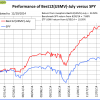
The backtest reported in this article showed that ranking the holdings of USMV, the iShares MSCI USA Minimum Volatility ETF, and selecting a portfolio of the 12 top ranked stocks, provided higher returns for the buy&hold portfolio than for the underlying ETF. To test these findings out-of-sample we launched the Best12(USMV)-July-2014on Jun-30-2014 and the first sister model Best12(USMV)-Oct-2014 on Sep-29-2014. Holdings and performance have been published weekly on our website since then. So far to Dec-15-2014 these portfolios have gained 19.2% (6.8%) and 10.5% (5.3%), respectively. (USMV gains are in brackets.) The test will be expanded by the launch on Jan-5-2015 of the second of the three sister models quarterly displaced, the Best12(USMV)-Jan-2015, which again will consist of the 12 highest ranked stocks of the then point-in-time holdings of USMV.
Read more >
With reference to Section 202(a)(11)(D) of the Investment Advisers Act:
We are Engineers and not Investment Advisers,
read more ...
By the mere act of reading this page and navigating this site you acknowledge, agree to, and abide by the
Terms of Use / Disclaimer