
-
After remaining invested through SPY’s 4.4% decline on November 5, iM-DrawdownShield has issued a conditional sell alert for Monday, November 23.
-
Monday’s sell trigger is $693.83, approximately 0.6% above Friday’s SPY close of $689.81. No further market decline is needed to trigger a switch.
-
The short-, medium- and long-term indicators have weakened, explaining why Friday’s smaller decline carries greater significance than the November 5 sell-off.
-
If SPY closes below $693.83 on Monday, the model signals a switch from SPY to SHY. Otherwise, it remains invested.
-
The model has held SPY since April 30, 2025, and follows fixed, rules-based signals rather than attempting to forecast market movements.
On November 8, we published Don’t Sell After One Bad Day: Wait For A Rules-Based Timer To Turn Defensive. SPY had fallen 4.4% on November 5, yet the rules-based SPY timer, iM-DrawdownShield, remained fully invested. Its sell trigger was then roughly 7% below the market: one bad day was not enough to reverse the model’s position.
Two weeks later, the position is unchanged, but the trigger has caught up with the market. After Friday’s close of $689.81, the trigger for Monday, November 23, is $693.83, approximately 0.6% above Friday’s close. The model, which has held SPY since April 30, 2025, now displays a conditional sell alert:
iM-DrawdownShield · Fri, Nov 20, 2026
Holding SPY · SPY close $689.81
Sell SPY, buy SHY if SPY closes below $693.83 in the next session (+0.6%).
A sell trigger above the latest close may look odd. It means that SPY need not fall any further for the model to switch: even a modest rise on Monday could leave the closing price below the trigger. Only a close at or above $693.83 would keep the model in SPY for another session.
Figure 1 shows how the three time frames reached this point.
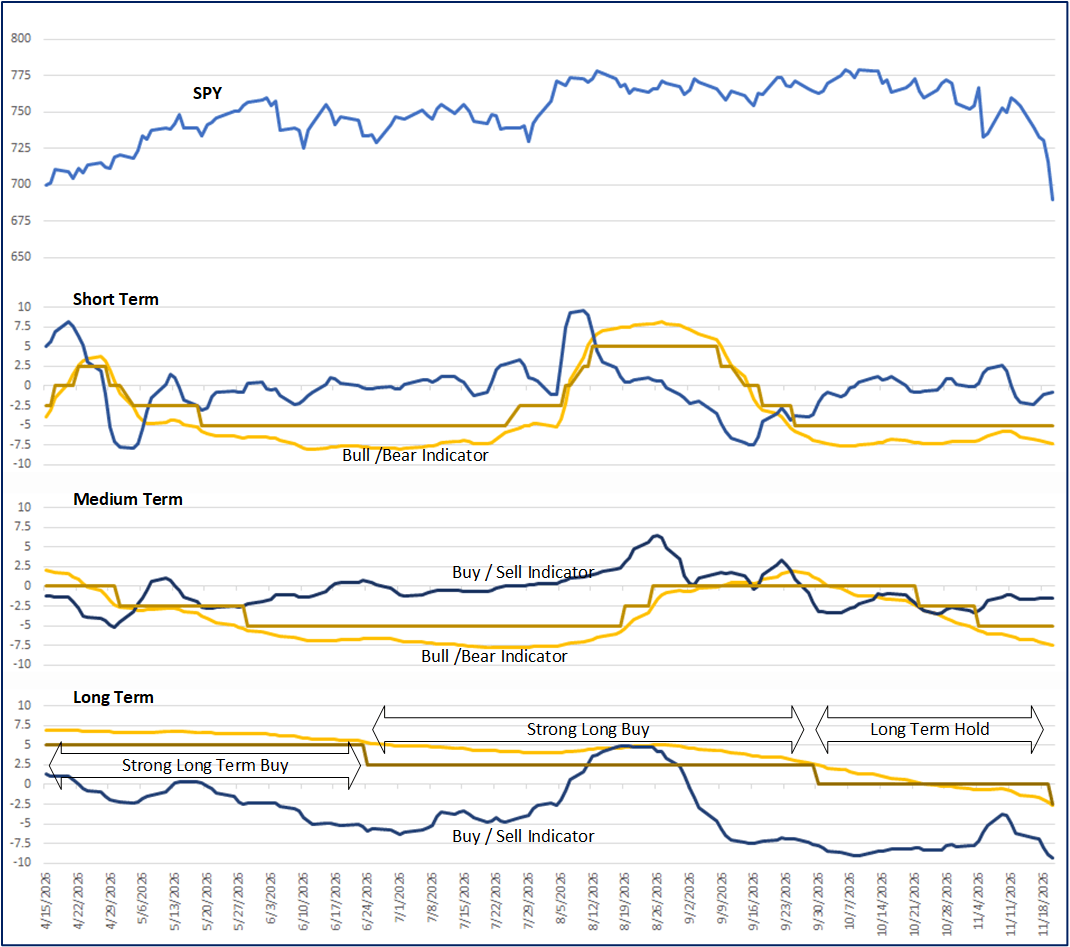
Figure 1 – SPY and the three iM-DrawdownShield indicators, April 15 – November 20, 2026. Top: SPY daily closing price. Below: short-term (about one month), medium-term (about three months) and long-term (about one year) readings. The yellow line is the bull–bear indicator, measuring trend strength; the dark blue line is the buy–sell indicator, measuring the direction and momentum of that trend. Both run from −10 to +10. The stepped brown line shows the trend rating in increments of 2.5. By November 20, all three buy–sell readings were negative, and the long-term trend rating had also slipped below zero.
Three things stand out
First, the short-term trend has been bearish since early November. It was an early warning of weakness, but a short-term decline alone does not prompt a trade. That was the point of our previous article.
Second, the medium-term trend has deteriorated. Its bull–bear indicator moved deeper into negative territory during November, while the buy–sell indicator remained on the bearish side. The weakness was no longer confined to a short-lived decline.
Third, the long-term trend has also weakened. Its rating moved from Strong Long-Term Buy earlier in the year, to Strong Long Buy in the summer, and then to Long-Term Hold in October. In the last week the rating stepped below zero, while the long-term buy–sell reading became strongly negative.
The model does not sell simply because SPY has suffered a large daily loss. It requires the buy–sell readings in all three time frames to meet their respective negative thresholds. These thresholds depend on the underlying bull–bear readings: the more bullish a time frame remains, the stronger the downward momentum required to justify an exit.
That explains why the two November sell-offs produced different responses. On November 5, SPY lost 4.4% in one session, but the broader combination of indicators had not met the exit rule. On November 20, SPY lost a smaller 3.6%, yet the medium- and long-term readings had weakened in the meantime. The Friday close left the model much closer to a defensive switch.
The trigger above the market is therefore not a forecast of Monday’s price. It is the closing-price boundary calculated from Friday’s data: the market would have to recover by approximately 0.6% to avoid the indicated switch.
What to watch on Monday
For Monday, November 23, the condition is straightforward:
- SPY closes below $693.83: the model switches out of SPY, with SHY named as the defensive holding in Friday’s alert.
- SPY closes at or above $693.83: the model remains in SPY, and a new trigger is calculated after Monday’s close.
In the model’s historical results, a signalled switch is recorded at the closing price. In live trading, an investor seeking to follow the signal would have to act near the close, so an actual fill could differ from that price. The updated position and next trigger will be shown on the iM-DrawdownShield live page after its daily update.
Method and disclosure
iM-DrawdownShield uses SPY’s adjusted daily closing prices and trading volume to determine whether to hold SPY or move to a defensive asset. When it exits, the Treasury ETFs are assessed using their own prices and volume. The model’s settings were developed using data from 2002–2019; the period from 2020 onwards was not used to set them.
All historical results are hypothetical, not actual trading results. They assume execution at the closing price when a previously published trigger is crossed; where a switch occurs without a prior alert, the rules use the following session’s close. The results exclude transaction costs, slippage and taxes. A live investor may not be able to execute at the stated closing price. Daily trigger levels have been published in advance since November 2026. Past performance does not guarantee future results. This article describes a mathematical model and is not investment advice.
Leave a Reply
You must be logged in to post a comment.